You know the feeling. It’s the tight knot in your stomach when you get a notification from your banking app. It’s the shallow breathing that starts the moment you think about next month’s rent. It’s the “freeze” response that makes you avoid opening your bills for weeks, even though you know ignoring them makes it worse.
If traditional financial advice—”just make a budget” or “stop buying coffee”—hasn’t stopped your panic, it’s not because you are bad with money. It’s because financial anxiety is not a math problem; it is a physiological problem.
When you stress about money, your body doesn’t know the difference between an overdraft fee and a saber-toothed tiger. Your nervous system shifts into survival mode (Fight, Flight, Freeze, or Fawn). In this state, your prefrontal cortex—the part of the brain responsible for logic, planning, and math—literally goes offline.
You cannot budget your way out of a panic attack. You have to regulate your body first.
This guide will teach you how to calm financial anxiety instantly using somatic exercises—body-based tools that speak the language of your nervous system to turn off the alarm bells so you can think clearly again.
Why Money Triggers Your Nervous System
To heal financial anxiety, we must stop shaming ourselves for having it. In the modern world, money equals survival. It is the resource we use to secure food, shelter, and safety.
When that resource feels threatened (or even just uncertain), your amygdala hijacks your brain. This is why “mindset work” or positive affirmations often fail in the heat of the moment. You cannot affirm your way out of a survival instinct.
Somatic therapy works differently. Instead of trying to think different thoughts to calm down, we use the body to send “safety signals” up to the brain. This is a “bottom-up” approach to healing.
Read More: If you are unsure if what you are feeling is normal, check out our guide on [Link: Physical symptoms of financial stress and how to heal them] to identify your body’s unique stress signals.
5 Somatic Exercises to Calm Financial Anxiety Instantly
These exercises are designed to be done in the moment—right before you check your bank balance, right after a declined card, or when you are lying awake at 3 AM worrying about debt. The infographic below provides a quick visual summary of three essential techniques.
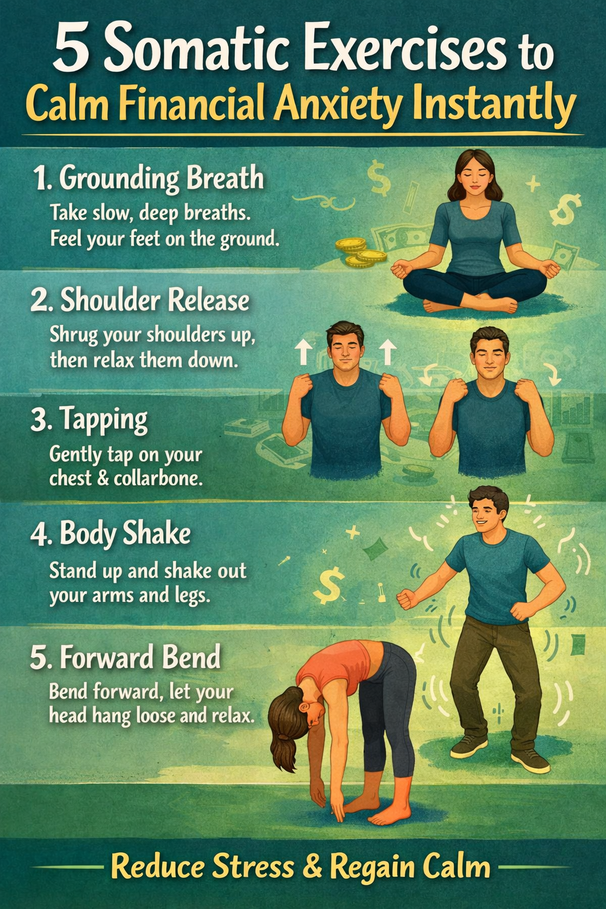
1. The “Wallet Weight” Grounding Technique
Best for: When you feel “floaty,” ungrounded, or avoidant (The Flight Response).
This exercise uses tactile sensation to bring you back to reality and safety. We often view our wallets as sources of pain. This reclaims the wallet as a neutral object.
How to do it:
- Sit in a comfortable chair with your feet flat on the floor.
- Hold your wallet (or your phone, if that’s where you bank) in both hands.
- Feel the weight of it. Notice the texture. Is the leather cool or warm? Is the phone smooth?
- Take a deep breath in through your nose for 4 counts.
- As you exhale for 6 counts, physically push your feet down into the floor.
- Say out loud (or whisper): “I am safe in this moment. This is just leather and paper. It cannot hurt me right now.”
Why it works: By engaging your sense of touch and proprioception (body position), you interrupt the dissociation that often happens when we fear checking our accounts.
2. The Physiological Sigh (Resetting the Alarm)
Best for: Acute panic, racing heart, or hyperventilation (The Fight/Flight Response).
Research popularized by neuroscientists has shown that the “physiological sigh” is the fastest way to offload carbon dioxide and slow down a racing heart.
How to do it:
- Inhale deeply through your nose.
- At the very top of that inhale, take a second, shorter, sharp inhale through the nose (to fully inflate the sacs in your lungs).
- Exhale fully and slowly through your mouth, making a soft “whoosh” sound, until your lungs are completely empty.
- Repeat 3 times.
Application: Do this immediately before logging into your banking app. It manually switches your nervous system from Sympathetic (stress) to Parasympathetic (calm).
3. The “Voo” Sound for Vagus Nerve Stimulation
Best for: The “Freeze” response (paralysis, inability to take action, procrastination).
When you are frozen—staring at a bill but unable to pay it—your dorsal vagal nerve is active. To get out of freeze, you need gentle stimulation of the Vagus nerve, which runs through your vocal cords and diaphragm.
How to do it:
- Take a deep breath into your belly.
- As you exhale, make a low, foghorn-like sound: “Voooooo.”
- Focus on the vibration. You should feel it rumbling in your chest and belly, not just your throat.
- Pause and notice the silence after the sound.
- Repeat for 1-2 minutes.
This vibration stimulates the vagus nerve, signaling to your body that the threat has passed and it is safe to move again.
4. Peripheral Vision Softening
Best for: Tunnel vision and obsessive worry.
When we are in “predator mode” (hunting for danger/worrying about money), our vision narrows. We literally get tunnel vision. By voluntarily widening our field of view, we can trick the brain into relaxing.
How to do it:
- Look straight ahead at a point on the wall.
- Without moving your eyes, try to see what is to the far left and far right of your room.
- Soften your gaze so you are taking in the whole room at once, rather than staring lasers at one object.
- Notice how your jaw naturally relaxes when your eyes soften.
5. The “Safety Container” Tap (EFT)
Best for: Racing thoughts and “What if” loops.
Emotional Freedom Technique (EFT) or Tapping is powerful for money blocks. We will use a simplified version here.
How to do it:
- Use two fingers to gently tap on the side of your hand (the “karate chop” point).
- Tap rhythmically while focusing on the fear (e.g., “I’m scared I won’t make rent”).
- Acknowledge the fear, don’t fight it.
- After 30 seconds, switch to tapping on your collarbone.
- Say: “Even though I feel this fear, I am grounded right now. I am open to solutions.”
Deep Dive: If you struggle with panic specifically when spending, read our guide on [Link: Why do I panic when spending money even if I have it].
When to Use These Tools (Creating a “Money Ritual”)
The goal isn’t to never feel stress again; it’s to stop the stress from controlling your actions. To heal your relationship with money, you need to “sandwich” your financial tasks with somatic safety.
The “Safe Banking” Protocol:
- Before you look: Do 3 rounds of the Physiological Sigh.
- While you look: Use the “Wallet Weight” technique. Keep feeling your feet on the floor.
- After you look: Shake it out. Literally. Stand up and shake your hands and legs for 10 seconds. Animals shake after trauma to release the adrenaline. You should too.
By doing this, you are teaching your nervous system a new pattern: Money does not equal death. Money is safe to look at.
Moving From Coping to Healing
These exercises are the first aid kit. They stop the bleeding. But true financial healing comes from digging deeper into the beliefs and traumas that caused this dysregulation in the first place.
You might find that your anxiety isn’t just about the number in the bank, but about deep-seated beliefs you inherited from your family. Are you carrying “ancestral scarcity”?
If you constantly self-sabotage the moment you start saving money, your nervous system might actually be uncomfortable with success because it feels unfamiliar.
Next Steps:
- Explore Beliefs: Read about [Link: How to release ancestral money trauma beliefs] to see if your anxiety belongs to your parents, not you.
- Understand the Freeze: If you feel stuck, check out [Link: Overcoming the freeze response when looking at bank accounts].
Conclusion
You have the power to change your physical reaction to money. It starts with the breath, the feet, and the body. The next time you feel that familiar wave of financial panic, remember: You don’t need to fix your bank account in this second. You just need to regulate your body. Once you are calm, the solutions will come.
Medical & Professional Disclaimer: I am not a medical doctor, licensed therapist, counselor, or qualified financial professional. The content and information provided throughout this website and within this article are intended strictly for educational and informational purposes only. This material should not under any circumstances be interpreted or utilized as a substitute for professional medical advice, diagnosis, treatment, mental health counseling, or professional financial planning and legal counsel. Always consult with a certified healthcare provider or qualified professional regarding any specific physical, mental, or financial concerns you may have.